


The stone guide
Why the best stones
no longer come out of the ground.
Lab-grown gemstones, moissanite and cubic zirconia are not imitations of something better. They are three different materials, each with a reason a jeweller would choose it. This is the honest version — and then the pieces.
Skip to the pieces Buy 2, Get 1 Free- Free worldwide shipping
- Lifetime warranty
- 100,000+ customers
Where this started
We bought a three hundred euro bracelet
and had it taken apart.
Stainless steel. A stone worth a few euro. The kind of piece that leaves a workshop for a fraction of what the shop window says. We were not angry about the margin — we were annoyed at how little of it was the jewellery.
So we went to the workshops themselves. The same ones that produce for names you would recognise. We asked what a piece actually costs to make properly, and what it would take to make ours better. Then we removed the boutique, the distributor and the importer.
What we learned along the way is the part nobody explains at the counter: the stone is rarely the expensive part. Finding it is. And there are now three materials that skip that step entirely — not by cheating, but by making the stone instead of hunting for it.
The part nobody explains
Four hundred million years,
or three weeks.
A sapphire forms under a mountain under heat and pressure, over a span of time nobody can picture. Then it has to be found, dug out, sorted, cut and moved halfway around the world before anyone sees it.
The same crystal, grown in a sealed chamber from the same element, under the same heat and pressure — only faster, and on purpose. Aluminium oxide is aluminium oxide whether it took an era or three weeks.
This is the whole mechanism. Not a cheaper imitation — a shorter route to the same material. Everything you are about to read follows from it.
Hardness, honestly
The Mohs scale, without the marketing.
Mohs measures scratch resistance from 1 to 10. It is the single most useful number in jewellery, and the one shops mention least.
mined or lab-grown9
5A+ grade8.5
natural7.5
Read it twice, because it undoes a few assumptions. Moissanite is harder than sapphire. A lab-grown sapphire is exactly as hard as a mined one — same mineral, same 9. And both are harder than a natural emerald, which is one of the most expensive stones in the world and chips if you look at it wrong.
Nothing here is harder than diamond, and we are not going to pretend otherwise. But above 8 on this scale a stone survives daily wear — showers, gyms, salt water, car keys. That is the line that actually matters for something you never take off.
The part that is harder to talk about
Nothing was dug for this.
A large share of the world's coloured gemstones comes out of small, informal mines with little oversight. Often hand-dug. Often in conditions nobody would accept in a factory. It is the part of the trade that never makes it onto the certificate, and the part that is almost impossible to trace once a stone has changed hands four times.
A stone grown in a sealed chamber has no such supply chain. There is nothing to trace, because nothing was dug. We are not claiming this makes us virtuous — it is simply a consequence of how the material is made, and it happens to be the right one.
Three materials
Which one is for you.
They are not better and worse versions of each other. They do different jobs.
Lab-grown gemstones
The real mineral. Colour with depth, and a stone a gemologist would call a sapphire.
Mohs 9 → 02Moissanite
Harder than sapphire, and it throws more fire than a diamond. The showpiece.
Mohs 9.25 → 03Cubic zirconia
Maximum brilliance for the money, hard enough to wear every day without thinking.
Mohs 8.5 →Lab-grown gemstones
A real sapphire. Grown, not found.
Same element, same crystal structure, same hardness, same fire as a stone pulled out of a mountain. A jeweller cannot tell them apart by eye — it takes an instrument, because the only difference is how long it took. Every pendant below is set in solid 925 silver on a stainless steel Cuban chain, with a 1 or 2 carat lab-grown stone.


Moissanite
Harder than sapphire.
More fire than a diamond.
Moissanite is silicon carbide — a different material altogether, and one of the hardest substances used in jewellery at 9.25 on Mohs. It also has a higher dispersion than diamond, which is the technical way of saying it throws more coloured fire under a light. That is why it reads as louder across a room, and why it is the one people notice.


Cubic zirconia · 5A+ grade
The most brilliance
per euro there is.
We will be straight about this one: cubic zirconia is not a fine-jewellery stone, and nobody serious pretends it is. What it is, is the best value in the case. At 8.5 on Mohs it is harder than a natural emerald and hard enough to wear every single day, and a well-cut stone throws light in a way that costs ten times more in any other material. Every piece below uses 5A+ grade stones — the top grade for cut and clarity, which is the whole difference between a stone that looks like glass and one that does not — hand-set one at a time on a stainless steel core.

Tennis Bracelet
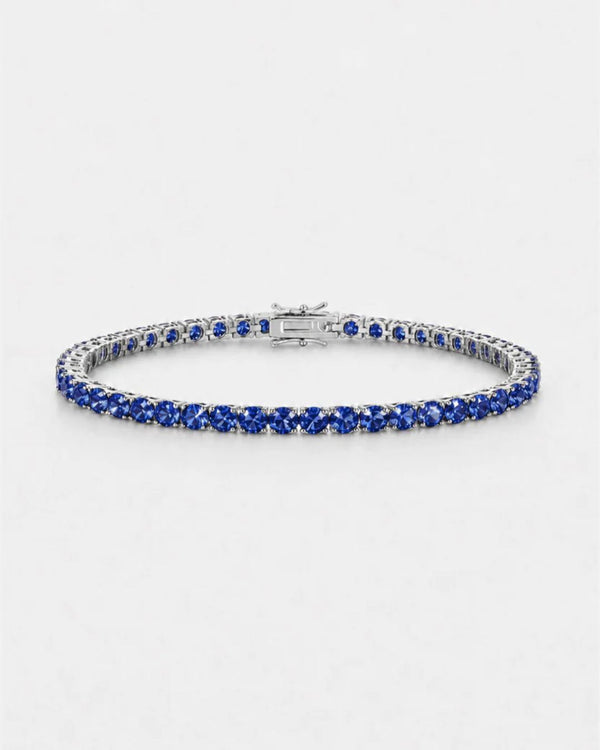
Sapphire Blue · Silver
$57 $69

Square Tennis Bracelet
Sapphire Blue · Silver
$59

Tennis Bracelet
Quartz · Silver
$57 $69

Tennis Bracelet
Onyx Black · Silver
$57 $69

Tennis Bracelet
Sapphire Blue · 14K Gold
$63 $75

Tennis Necklace
Sapphire Blue · Silver
$104 $139
Side by side
The three, compared.
| Lab gemstone | Moissanite | Cubic zirconia | |
|---|---|---|---|
| Mohs hardness | 9 | 9.25 | 8.5 |
| What it is | Real corundum | Silicon carbide | Zirconium dioxide · 5A+ |
| Fire | Like a mined stone | More than diamond | High |
| Daily wear | Yes | Yes | Yes |
| Reads as | Quiet, deep colour | Loud across a room | Bright, clean |
| From | $96 | $692 | $57 |
Lifetime warranty
If it tarnishes, fades or breaks under normal wear, we replace it. No time limit.
Free worldwide shipping
On every order, no minimum. Tracked from the moment it leaves us.
Easy returns
Wrong stone, wrong size? Send it back. We would rather you wear something you like.
Before you ask
The questions we get most
Is a lab-grown sapphire a real sapphire?
Yes. It is corundum, the same mineral, with the same chemical composition, the same crystal structure and the same 9 on the Mohs scale. A gemologist distinguishes them by looking for growth patterns under magnification, not by looking at the stone. The difference is the method, not the material.
So why is a mined one so much more expensive?
Because finding it is the expensive part. Exploration, extraction, sorting, certification and a chain of hands between the ground and the counter. None of that is the stone. Growing removes the search, and the price follows.
Which should I pick?
If you want deep, quiet colour and the actual mineral, take a lab-grown gemstone. If you want the piece people comment on, take moissanite — it is harder and it throws more fire than a diamond. If you want the most brilliance for the money in something you will wear every day without thinking about it, take cubic zirconia.
What does 5A+ mean, and is it the same as zircon?
5A+ is the top grade for cut, clarity and colour consistency in a cubic zirconia — it is a quality grade, not a different material. Two stones can both be cubic zirconia and look nothing alike, and the grade is why. One thing worth clearing up: cubic zirconia is not the natural mineral zircon, which is a different and considerably softer stone. Ours is cubic zirconia at 8.5 on Mohs, graded 5A+, and we would rather say that plainly than lean on a word that sounds rarer than it is.
Will any of these scratch?
Everything we set is 8.5 or above, which is above the hardness of ordinary dust and sand and well above what daily life throws at a wrist. For comparison, a natural emerald sits at 7.5. Only diamond will scratch our stones, and you are unlikely to rub two together.
Can I shower, swim and train in it?
Yes. Everything is built on stainless steel or solid 925 silver, and it is made to stay on. Most of our customers put a piece on and never take it off.
How does Buy 2, Get 1 Free work?
Add three pieces to your cart and the cheapest one comes off at checkout. Mix across everything on this page — a pendant, a tennis bracelet and a moissanite piece all count. No code needed.
Three materials, one offer
Pick two.
The third is on us.
Mix across all three — a lab-grown pendant, a moissanite bracelet, a tennis piece. The cheapest of the three comes off at checkout.
Claim your free piece Buy 2, Get 1 Free- Free worldwide shipping
- Lifetime warranty
- Easy returns